
Welcome back to Myths & Mischief! This is your Lovable Lord of Lore, today’s mischievous myth is continuing the dive down the rabbit hole with today’s installment of Edgar Allen Poe’s Final Macabre Mystery.
This is the 1st part of a short story that gives a possible explanation of famous author Edgar Allen Poe’s demise.
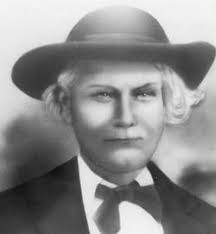
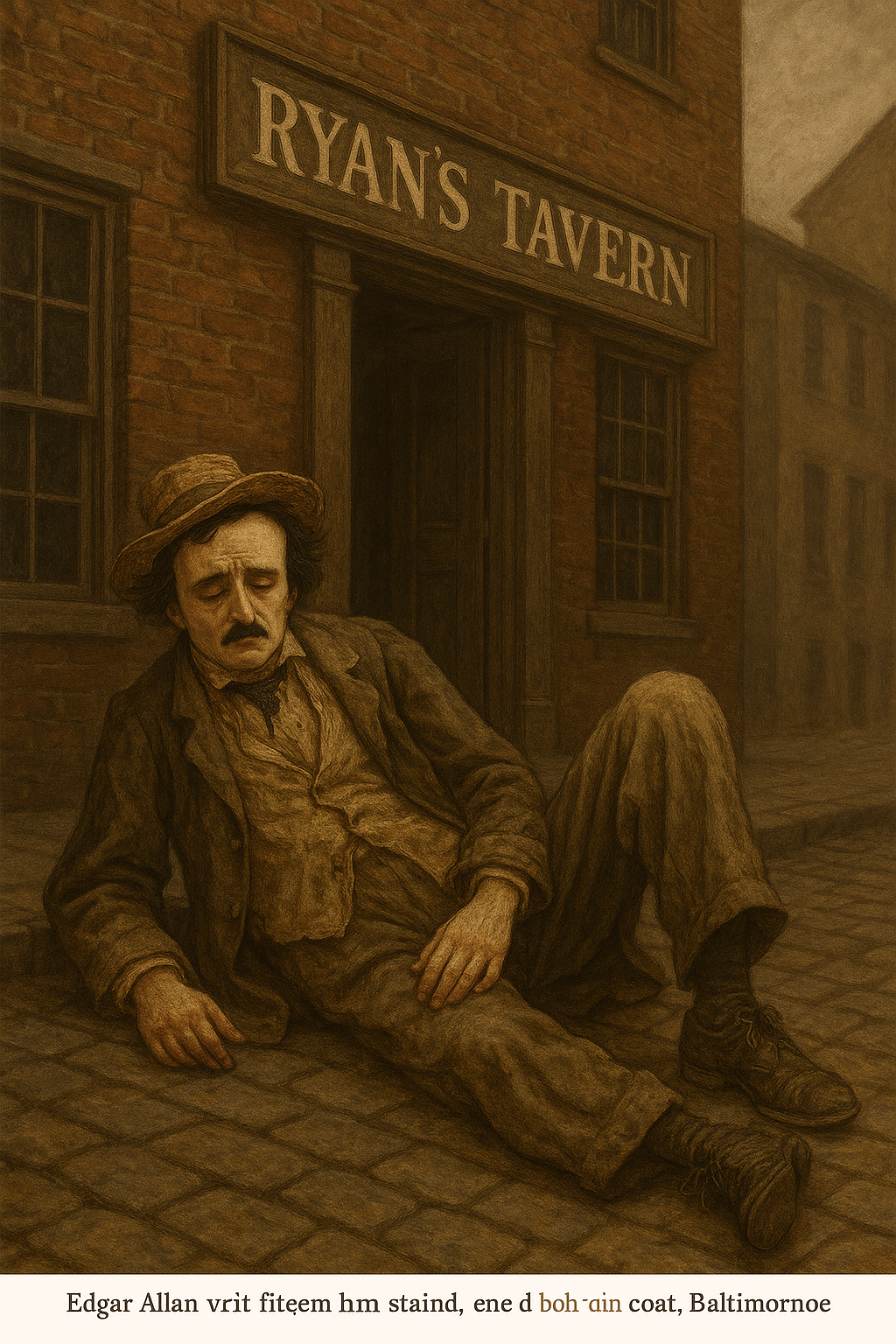
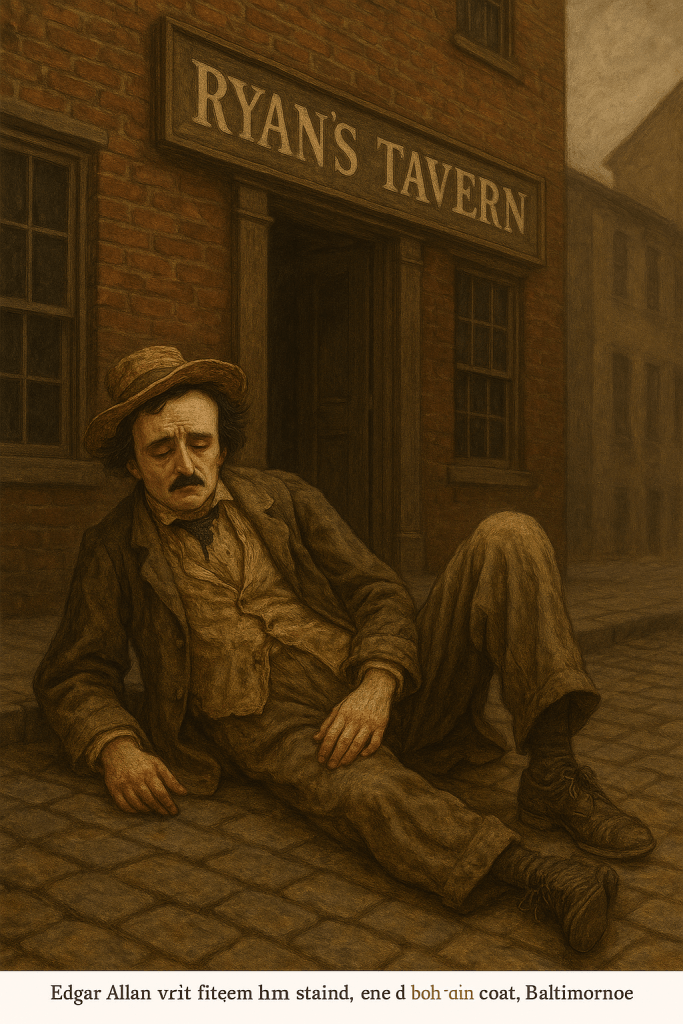
It was a rainy day at Ryan’s Tavern, also known as Gunner’s Hall in Baltimore. It was a tavern as well as a polling location for voting. The elections of October 2nd, 1849 had just concluded and politics was the topic of the day. A local Printer was in the bar to gauge the reaction of the people. Joseph Walker knew that bars were the perfect place to get the pulse of the community since drinking tended to loosen the lips of otherwise quiet dissent or praise.
In the bar, people were complaining that the election was rigged, or alluded to the practice of cooping where gangs of people beat, drugged or imbibed people to vote several times in different locations, or in the same location with different clothes and disguises like fake beards and wigs. As 2 patrons were getting louder and angrier in their disagreement over the validity of the elections of John Sellman as the Sheriff and Elijah Stansbury Jr. as mayor. Walker decided he had been there long enough and headed out the door wishing to stay clear of the conflict. Upon his exit, he came across a man laying in the street, just outside the bar. He recognized him as the famous writer Edgar Allen Poe and rushed to his aid.
Poe was disheveled and muttering. Walker recognized the name of a local magazine editor Joseph Snodgrass as Poe begged for his assistance. He looked around, there were several people passing by. He pulled out a pen and paper and quickly scribbled on the parchment. He asked for someone to fetch help for transporting Poe to the hospital via horse-drawn-cart, as well as quickly dispatching a note to Snoddgrass reading:
“Dear Sir—There is a gentleman, rather the worse for wear, at Ryan’s 4th ward polls, who goes under the cognomen of Edgar A. Poe, and who appears in great distress, & he says he is acquainted with you, and I assure you, he is in need of immediate assistance. Yours, in haste, Jos. W. Walker”

After dispatching the note, he sent Poe to the Washington College Hospital, where he was treated for intoxication. Snodgrass had just arrived when Poe was brought in, but Poe was rushed into treatment. He was left in the care of Dr. John Joseph Moran and kept in a prison-like room with barred windows that was used for drunkards.
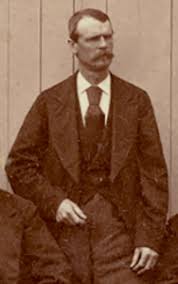
John Moran was an aging doctor who aimed to please people, even if that meant telling some white lies, or that is what he told himself, especially if he had trouble remembering details of his work.
Dr. Moran, judging by Poe’s worsening physical condition after 5 days of treatment called the authorities. An investigator, Robert Thompson answered the call. As he started for the door he called a young inspector, Carl Wilson to come with him for the experience. When they got to the hospital they entered and sought out the doctor. As they waited for the doctor to arrive, the two officers conferred on their knowledge of the famous author. They knew that his stories were dark, and the loss of loved ones was a frequent occurrence in his stories. They agreed that self harm may be responsible for Poe’s condition.
Dr. Moran approached the officers with grim news. Edgar Allen Poe was dead. Thompson inquired “Why did you think to call on us?”
Dr. Moran went over what he observed upon Poe’s arrival. “He came in wearing a stained, faded, old bombazine coat, pantaloons of a similar character, a pair of worn-out shoes run down at the heels, and an old straw hat”. Poe was never coherent long enough to explain how he came to be in this condition, and I believe the clothes he was wearing were not his own not least because wearing shabby clothes was out of character for him.” Then he went on to explain what he had observed while Poe was under his care. “Poe did not have any visitors but he did call out for someone named Reynolds but gave no clues or explanation to his predicament.”
Wilson asked, “Had he gone mad or was he ill? Didn’t he start a story with the line:
“It’s true! Yes, I have been ill, very ill. But why do you say that I have lost control of my mind, why do you say that I am mad?”
Who is Reynolds? asked Thompson, putting an end to Wilson’s witticism.
Wilson interrupted, “Wasn’t that the name of the newspaper editor and explorer?”
“It is also the name of one of the judges overseeing the 4th Ward Polls at Ryan’s Tavern.”
“What did he say about Reynolds?” pressed Thompson.
“Nothing, he called out the name several times but with no context. In trying to cheer him up, I told him that he would soon be enjoying the company of friends.” Dr. Moran hesitated before continuing on.
“He replied that the best thing his friend could do would be to blow out his brains with a pistol.” said Dr. Moran with a sense of exasperation in his voice.
“Poor bastard, what did you rule as a cause of death?” asked Thompson.
“I left that part blank, which is why I called, I really don’t know, so I thought you might be able to answer that question for me so I can finish the paperwork.” replied the doctor.
“Have you notified his next of kin?” asked Thompson.
“I had to send someone out to find out who that would be and I gave them a letter to send, I don’t believe he had family in town.”
“Is there any other information that we can use in our investigation, or did he have any belongings?”
“He only came in with the clothes on his back. I would need more information about Poe, but there could be a number of explanations that somewhat fit. It could have been congestion of the brain related to alcohol or something that looks like that (now known as hypoglycemia), a serious blow to the head, tuberculosis, a brain tumor, rabies, coal gas poisoning (now known as carbon monoxide poisoning), drugs, cholera, syphilis, apoplexy, delirium tremens, heart disease, suicide, an overdose of laudanum or lead or mercury poisoning. It could have been as simple as food poisoning, I really can’t tell at this point”
“So it could be anything?” clarified Thompson.
“I’m afraid so.”
“It looks like we have a lot of work to do, we’ll check in with you later.” Thompson said, then shifted his focus to Wilson.
“Wilson, let’s go to the tavern and see what we can find out, perhaps we can interview the Reynolds there.” said Thompson gesturing to the door.
On the way to the tavern, the two inspectors reviewed their notes agreeing that neither of them had any idea as of yet to what transpired to put the famous writer in his deathbed.
“On the way we should send word to Poe’s family to come to town in case they have any information.” Thompson offered.
“Who would have that information?”
“We’ll pay a visit to Snodgrass, he knew Poe and might know who to contact.”
Thompson and Wilson made their way to the magazine editor’s office.
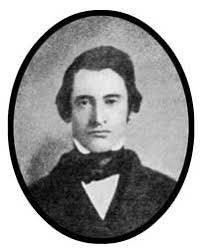
Snodgrass saw them enter and hurried over to them.
“We are looking for Joseph Snodgrass.”
“That’s me, how can I help you gentlemen?”
“We are investigating the events surrounding the author Edgar Allen Poe and his activities here in Baltimore.”
“Yes, I received a note and rushed to the hospital. I was there when he was admitted. The note said he was in a state of beastly intoxication, it really is the scourge of our time. When I saw him, he was repulsive, with unkempt hair, a haggard, unwashed face and lusterless and vacant eyes. His clothing,” Snodgrass said, which included a dirty shirt but no vest and unpolished shoes, was worn and did not fit well.”
“What do you make of his appearance?”
“When sober, he was a brilliant man, but when drunk or drugged, who knows what was going on with him. Perhaps when he lost his vest, he picked up someone else’s coat. He was known for going on benders and seemed to disregard his senses. He was more drunk than anyone I have seen.”
“Was there anything else that you noticed? Thompson asked as Wilson tapped him on the shoulder while adding “Do you know of any friends or family that we can wire to see if they knew of the cause of such a bender?”
“No, I never had a chance to speak with him and he was kept in a room that didn’t allow visitors. It is my understanding that he was being treated for congestion of the brain.”
“A sobering thought, and the contacts?” asked Wilson
“Yes, I can help you there, I knew Poe professionally, and I know of his aunt, Maria Clemm, and I understand he was pursuing a relationship with Sarah Elmira Royster. I have their information in my office.”
Snodgrass scurried away and returned with a slip of paper that had the addresses of Poe’s aunt and possible significant other. He handed the paper to the inspector.
“Thank you for your help, if you think of any other pertinent information, please let us know.”
“I will.”
The investigators had one more stop before going to Ryan’s Tavern. It was a quick stop to hire some riders to contact his family and request that they come to Baltimore. “Maybe they will have some answers.”
Upon their arrival to the tavern, also known as Gunners Hall, they looked around outside. There was no evidence that Poe was ever there. People that were on the street were just passing by, and wouldn’t have been there when Poe was found.
They headed into the bar. They meandered up to the barkeep and asked about where to find Judge Reynolds. The barkeep pointed to the corner of the bar where a man sat with a half a beer in front of him. He looked exhausted, yet relieved. The inspectors approached him and he gestured for them to sit down before introductions were made. “Pull up a chair gents, how can I be of service?”
“We are investigating the death of Edgar Allen Poe.” said Thompson as he started his inquiries.
A hush fell over the bar that had been bustling just moments before. Reynolds sat up straight. “I see.” he said. The attention of the whole bar was on the investigators.
Poe was found on the street just outside this establishment. Where were you on election day specifically, were you in the bar, or somewhere close by?”
“I was in here, tables were moved out of the way to accommodate the voters, then returned after the election was over.”
“As a judge, did you see everyone that voted in this location?”
“I did.”
“Did Mr. Poe come in either to vote or to drink?”
“I didn’t see him.”
“Would you have recognized him?”
“Everyone knows what Poe looks like. From his time living here, he was always well-dressed and his look was unmistakable.”
“What if he was drunk or wearing someone else’s clothes?”
“Are you suggesting that I wouldn’t recognize one of America’s most famous writers? We are all fans of his work and consider him to be a son of Baltimore. He didn’t come in here, I would have recognized him if he came in wearing a dress and a fancy hat. He wasn’t in here.”
“We are well aware of cooping, as I am sure you are, was that an issue with this election or at this polling station?” pressed Thompson.
“I saw a lot of people come in here in various states, from what I could tell, there was no cooping here, but it is almost impossible to detect with that many people coming in to vote.”
“But you are certain that you didn’t see Poe.”
“I would have recognized him, so yes, I am sure. With that said, you may be interested in this…”

He handed them the evening edition of the paper that had been sitting in front of him. The front page was all about the victors of the election with Stansbury Jr. being the headline.
Open to the obituaries. He pointed to the one written by someone named Ludwig. It went on to say that Poe had few or no friends, and claimed that his death would startle many, but few will be grieved by it. It mentioned his wanderings in madness and melancholy and that he was often seen muttering and cursing to himself. The inspectors read on. Poe was easily irritate, envious, and cynically regarded in society because he lacked honor and a moral compass.
“Was this your impression of Poe?” Thompson asked after reading the obituary.
“I know he had a grudge with a writer and editor named Griswold who made similar claims. While I never witnessed him in such a state, by reading his stories, it does make some sense that he had issues.”
“Did you believe he was in a slow decline, like the House of Usher?
Reynolds shrugged as Thompson made a note of the name Ludwig and looked up from the paper at Reynolds and thanked him for his time and he and Wilson circulated around the bar to see if anyone had seen or heard anything but they came up empty.
Look Wilson, it is getting late, go home and we will go see Griswold tomorrow. It will take a few days for Poe’s family to return. I’ll see you at the office.
Alright Robert, see you then.
Both men returned home while possible explanations took over their thoughts and dreams like a macabre story of the recently perished author.
That’s it for this today’s installment, this is your Lord of the Lore signing off.
If you liked this tale, make sure to subscribe for more so you don’t miss the tomorrow’s installment of mischievous myths as the Poe saga continues!
 Myths & Mischief
You must be logged in to post a comment.