
Welcome back to Myths & Mischief! This is your Lovable Lord of Lore, today’s mischievous myth is about the Roman emperor Nero, and how his vanity started the decline of the empire.
Nero, fueled by ego, was the most powerful man who performed as his empire burned.
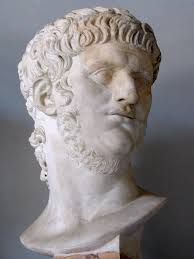
Nero was an unusual ruler in a number of ways that may sound familiar. The first part of Nero’s rule was productive and he ruled efficiently with guidance from his mother, Agrippina the Younger since he became emperor at age 16. His ego started to take over. He tore down his advisors. He had his mother killed. Then he had his first wife, Claudia Octavia killed. That was followed by the assassinations of his second wife, Poppaea and his step-brother, Britannicus. This gave him control of the empire without the limitations of tradition and restrictions.
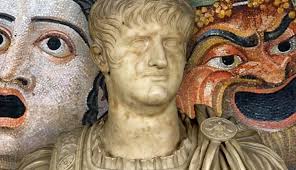
In order to stoke his ego, and consolidate his power by gaining the support of the poor and uneducated, he performed for them. The aristocrats and educated people disapproved that he performed as an actor, poet, musician, and charioteer as well as the topics of his performances, many involved the skeletons in his closet. He would explain how and why his family was killed. He went as far as to use masks that made to look like his deceased family members on stage.
The expectations for the audience in his mandatory performances was absolute silence. There are stories of a woman who gave birth silently so she would not be executed. Others faked dying so they would not have to attend the performances.
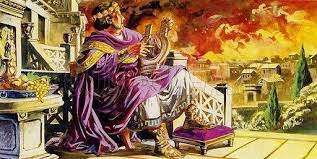
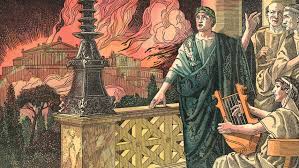
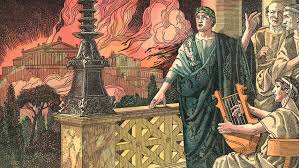
On one fateful night, Nero played music for his silent audience. Behind him, Rome was literally on fire and significant parts of Rome burnt to the ground. The audience didn’t dare to interrupt the performance. So Rome burnt while Nero strummed his lyre.
There were accusations that Nero had ordered the fire in order to clear land for his planned “Golden House.” Nero blamed the Christians for the fire and had them burned alive. He was less interested in justice than he was carrying out vendettas. Yet others felt the fire was accidental, but the lack of initial action caused more destruction than if the populace was not held hostage. The fire itself burned for more than 7 days before subsiding, then resparked and burned for an additional 3 days. The fire was started in merchant shops overlooking the the Circus Maximus and consumed mansions, residences of ordinary citizens, public buildings, and temples on the Aventine, Palatine, and Caelian hills. 3 of Rome’s 14 districts were destroyed.
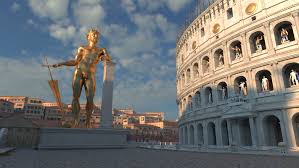
In the place of all the destruction, a lush artificial landscape with a 30-meter-tall statue of himself, called the Colossus of Nero, was planned. The Colosseum would eventually be built there.
To evade any punishments, Nero was credited for organizing a relief effort, and personally paid for the removal of the dead and debris and opened his own palaces for the newly homeless and had food brought in to prevent starvation. He needed a scapegoat, so much like claiming immigrants are the reason there is crime in America, Nero blamed the Christians and had groups of Christians tortured, fed to animals in the arena, and crucified.
Then he went on to build a new palace, called the Domus Aurea. Then he increased taxes to pay for rebuilding of Rome. The new structures were made of brick, not wood and more space was put between buildings. Most of the taxes were raised on provinces of the empire, which caused discontent. It also devalued the Roman currency and forced them to deal with inflation for the first time.
Nero attempted to rewrite his own history through performances where lies were the norm. Those who knew the truth dared not to speak up.
It must be difficult to imagine a ruler being so wrapped up in his own ego, that he would lie about his past, double down on his lies, and set up events to perpetuate his version in order to rewrite history. No leader would be so bold as to burn down their empire, devastating the economy while increasing the money spent on his own luxurious lifestyle. Could a ruler have so much power that he would attack anyone that offered a different narrative and cruelly unleashed his wrath on anyone that crossed him.
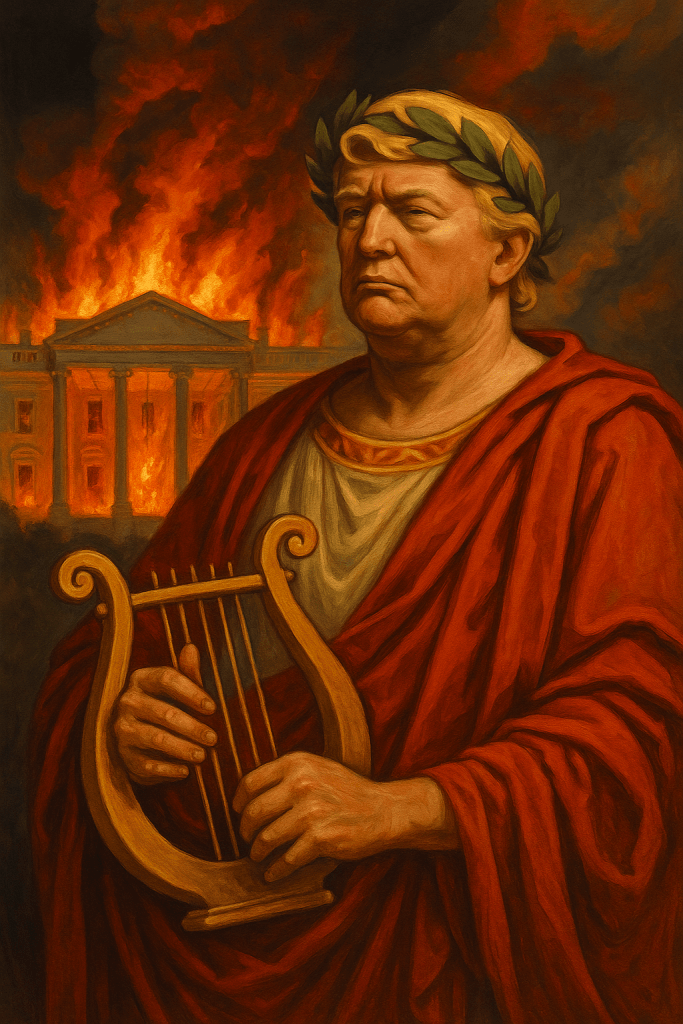
I’m sure that was all left in antiquity.
Nero went on to have multiple problems with the empire. This led to him being supplanted and condemned to death. Instead he fled Rome and committed suicide. What still lives on is his ego, and what he exemplified, the worst part of human nature that rears when unchecked by the rest of society.
That’s it for this week’s installment, this is your Lord of the Lore signing off.
If you liked this tale, make sure to subscribe for more so you don’t miss the next installment of mischievous myths!
 Myths & Mischief
You must be logged in to post a comment.