

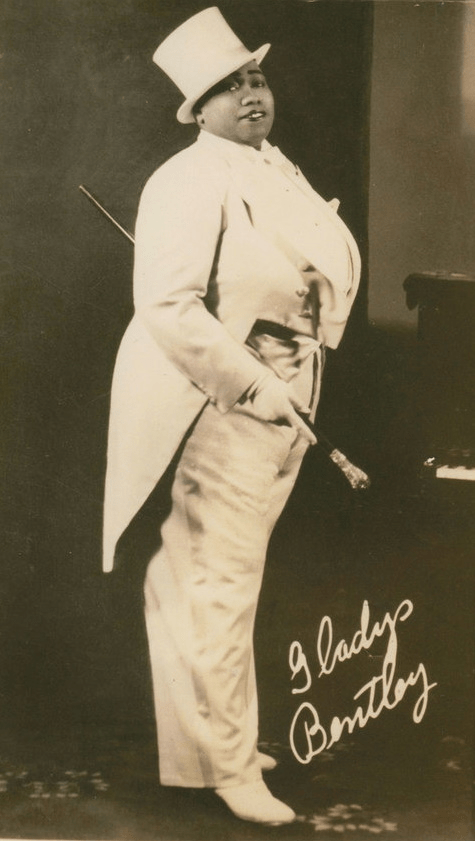
Hello there! My name’s Marlo, and I’m here with another Myths & Mischief blog for Pride Month! The focus for today is a woman names Gladys Bentley, an American entertainer of the famous Harlem Renaissance era. Just so you know, there is gonna be some very serious talk about the persecution of LGBT+ people below.

Gladys Alberta Bentley was born on August 12 of 1907 in Philadelphia, Pennsylvania. Her mother, Mary Mote, was from the Caribbean island of Trinidad. She was the eldest of four children, and her low-income, working-class family lived on Euclid Avenue in North Philadelphia. Her mother had wanted a son, and wouldn’t nurse her; Gladys’s grandmother had to nurse her with a bottle for 6 months. In her own opinion, growing up feeling rejected shaped Gladys’s behavior. She hated her brothers, and she adopted the clothing and mannerisms of boys. She preferred to wear her brother’s suits instead of dresses or blouses. Due to her gender non-conformity, she was teased by her peers and ostracized by her teachers and parents. She had crushes on women, which she did not understand until later.
Feeling inescapably isolated, uncomfortable, and out of place, Gladys ran away from home to New York City at 16 years old. She started playing piano at Harry Hansberry’s Clam House, a famous gay speakeasy on 133rd Street in Harlem. She began performing in men’s attire: oxford shoes, white dress shirts, bow ties, and formal jackets. She wore her hair slicked back. She became popular at Hansberry’s, and perfected her performance style. Her stage name at the time was Barbara “Bobbie” Minton, and Hansberry’s was renamed to Barbara’s Exclusive Club. She started performing at the Ubangi Club in 1933, which caused legal trouble with Harry Hansberry and Nat Palein of Hansberry’s, who said their club relied on her success. Her shows at the Ubangi appealed to Black, White, LGBT+, and cisgender-heterosexual audiences alike. Nevertheless, she received complaints for the raunchy content of her music, and some places where she performed had to be closed. Still, she became very successful, and went on tour. Destinations included Cleveland, Pittsburgh, Chicago, and Hollywood. She had several relationships with women, and referenced them in her music. She put a promiscuous spin on popular songs, and would flirt with women in the audiences of her shows. In August 1928, she signed with Okeh Records and recorded music for them.
She also recorded for the Victor, Excelsior, and Flame labels. Most of her singing is low, booming, and deep, but she could also reach high notes. She drew positive attention from celebrities of the time, such as Langston Hughes, Cesar Romero – the first actor to the play the Joker – and the blockbuster actors Barbara Stanwyck and Cary Grant. Bentley had a civil ceremony in 1931 with a woman, possibly one Beatrice Robert, in Atlantic City, New Jersey. Prohibition was repealed in 1933, and speakeasies declined afterward. Gladys relocated to southern California in 1937. Then, she reportedly married a man named J. T. Gibson. She performed in gay bars and music clubs, but never reached the level of success she had before. Federal laws changed, and Bentley had to have permits to perform while wearing men’s clothes. She was frequently harassed. The McCarthy Era was a period in which communist, socialist, anti-capitalist, and other left-wing people were rooted out and harshly persecuted by the federal government, led by U.S. senator Joseph McCarthy. During this era, from 1947 to 1959, gender non-conforming and other LGBT+ people were attacked, repressed, and arrested.
In 1952, J. T. Gibson died, and she ostensibly married a man named Charles Roberts after just knowing him for 5 months. This was doubtlessly done to get the McCarthyites off her back; she also started wearing dresses in public. On May 15, 1958, she appeared on a game show called You Bet Your Life, hosted by famed comedian Groucho Marx. She then sang “Them There Eyes” while playing piano. She turned to religion in the late 50s, and studied to be a minister. She got close, but this never came to be. She also took female hormones, and sought to find a “cure” to homosexuality after a “hell as terrible as dope addiction”. She wrote an essay, “I Am a Woman Again”, for Ebony magazine in 1959. Bentley unexpectedly died of pneumonia at her home in Los Angeles on January 18, 1960.
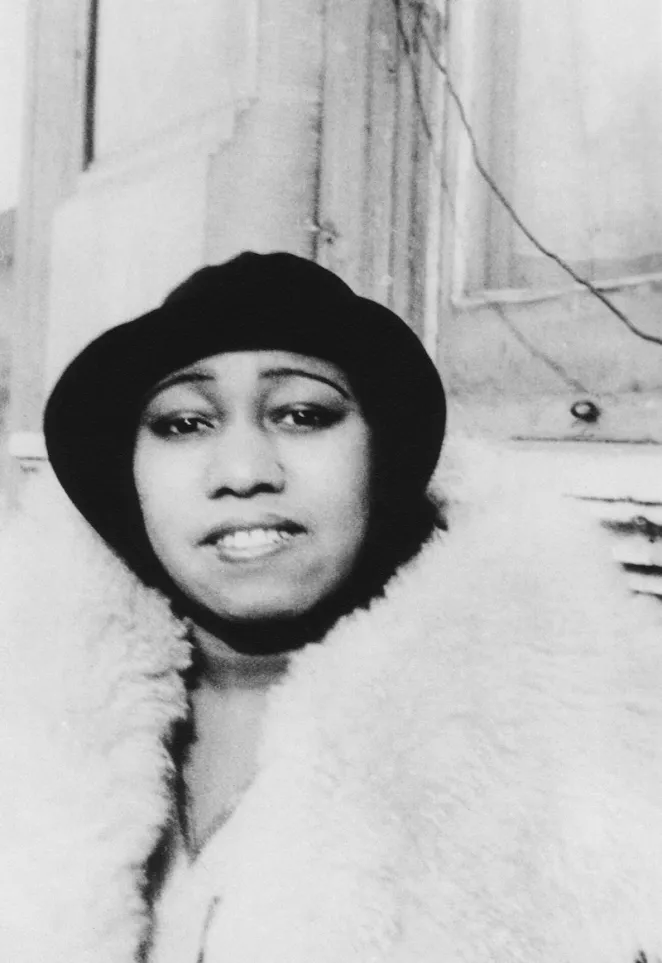
While Gladys Bentley was a singular and unique person, we can look at her life and fit it into a broader context. Gladys was a queer, Black woman who grew up in a world that didn’t make space for her. She pushed and shoved and sang and loved to make space for herself, but the world pushed back. Hard. The McCarthy Era was a brutal, reactionary period of persecution, and forced a lot of people push their queerness deep, deep down. Gladys, AKA Bobbie, despite her strength, her perseverance, her passion, was one of those people. It was this kind of silencing, this crushing of self expression and queerness and independent thought, that drove queer people in Bentley’s city, New York City, to conduct the Stonewall Riots 9 years after she died. It was power like Gladys had, determination like Gladys had, voices like Gladys had, that keep the LGBT+ rights movement going. It is historic figures like Gladys Bentley that prove that queerness is not new, and that queer people aren’t going anywhere anytime soon. Thank you, Gladys Bentley.
References:
<https://www.queermusicheritage.com/bentley1.html><https://queermusicheritage.com/bentley6.html><https://www.nytimes.com/interactive/2019/obituaries/gladys-bentley-overlooked.html><https://www.harlemworldmagazine.com/ubangi-club-harlem-new-york-1934-1937/><https://books.google.com/books?id=XHIGhKWPy9AC&q=hansberry+clam+house&pg=PP4><https://web.archive.org/web/20071103022225/http://www.glbtq.com/arts/bentley_g.html>Duckett, Alfred. "The Third Sex". *The Chicago Defender*, March 2, 1957.<https://www.youtube.com/watch?v=j-LTJNasTMc><https://www.youtube.com/watch?v=ptIBk2PZK74&list=RDptIBk2PZK74&start_radio=1>
 Myths & Mischief
You must be logged in to post a comment.