
It isn’t often that one may find themselves wholeheartedly crying because of — and for — a ship, much less an animated one, but this unique experience is one only One Piece can provide. The renowned anime and manga have gained a reputation within its own and overarching anime community for this very thing : the death of the Going Merry, the Straw Hat Pirates’ very first sailing vessel, and the profound, lasting impact it’s had on almost everyone who’s witnessed the loss.
Even now, for enthusiastic fans, this experience is used to entice those skeptical that One Piece is even worth the over 1000 episode/chapter commitment : “One Piece is so good, it’ll make you cry over a ship — A BOAT!” And, even now, newer fans give tearful testimony of how much this loss has affected them while on their journey of catching up.
To anyone unfamiliar with the story, the thought of being so deeply affected by the “death” of a ship may seem unreasonable or overly dramatic, but to many viewers and readers, it meant a great deal and continues to be thought of as a crucial turning point for the story. It served as one of the catalysts for the upending of the foundation and sanctity of the close knit crew in the iconic Water 7 and Enies lobby arcs; it forced our main character, Luffy, to fully step into his role as captain, taking charge and making difficult decisions to secure the safety of his beloved crew. But, without spending too much time extensively recounting various story arcs to explain to you the significance of such a tragic death, I’ll simply expound upon one facet of it, while also discussing the real-life influence found throughout seafaring legend.
The Klabautermann, Traditionally
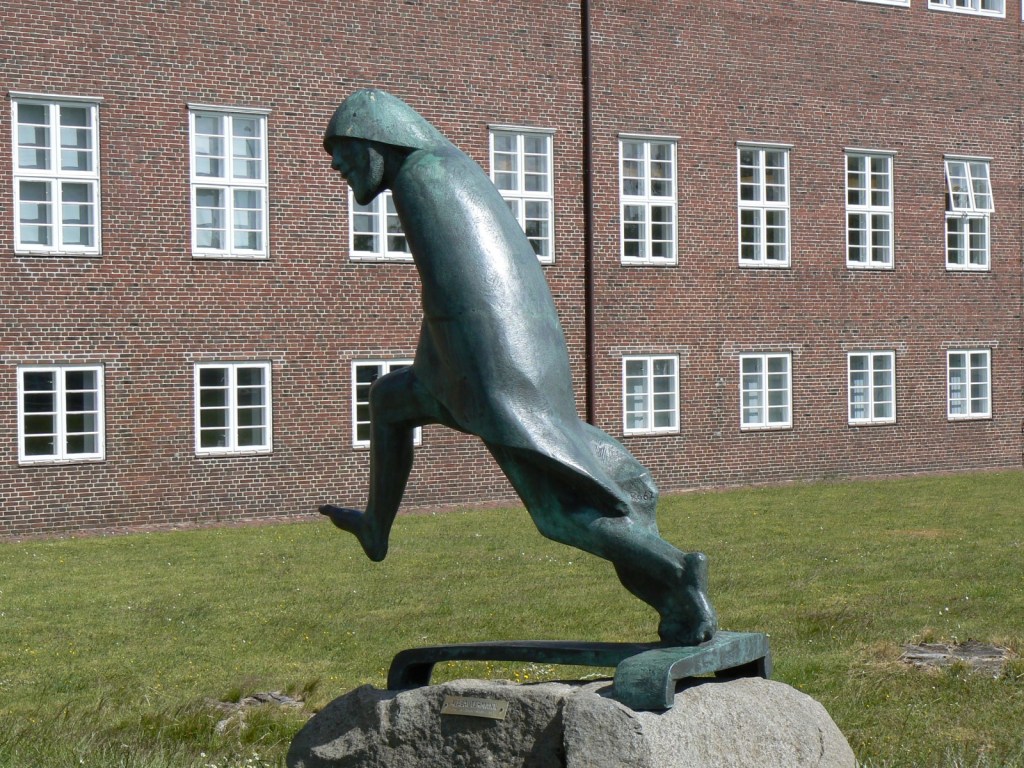
Klabautermann by Walter Rössler (d. 1996) at the maritime museum, Husum, Schleswig-Holstein
Klabautermann — pronounced kla-bow-ter-man — as named in both One Piece and German and Dutch folklore and legends, are historically thought to be water kobolds, or spirits, that assist sailors and fishermen on the Baltic and North Seas. To seamen, it’s arguably the most feared sight to lay one’s eyes upon on the high seas, as it’s believed to be a terrible omen, foretelling events that could harm the ship and bring doom to its crew. For example, it is said that the elusive spirit can predict thunderstorms, alerting the crew before it happens, giving them time to prepare. Though, if the ship is more likely to sink, it warns the captain and crew before abandoning the ship itself. But, if the crew have been diligent, just, and respectful to said ship, the Klabautermann is said to remain amongst them, helping with repairs. In legend, with its wooden mallet, it knocks upon the wood of the ship, signaling to the ship’s carpenter the location of leaks and rotten spots. And, in some cases, ships are completely repaired without notice.
The Going Merry’s Klabautermann
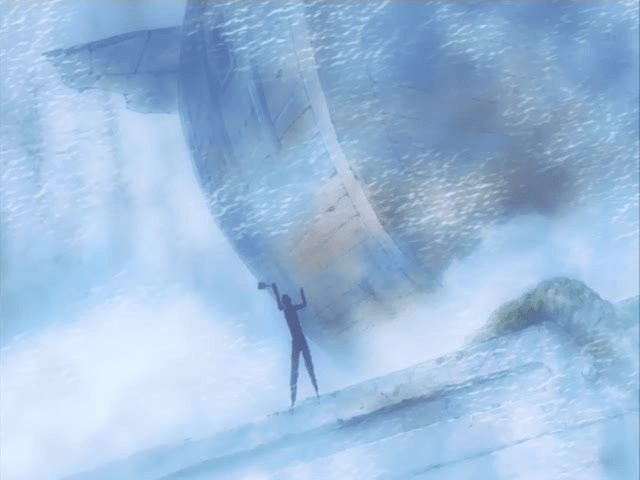

The One Piece counterpart in concept isn’t that much different from its real-life mythical parallel, even in design. With a human-like figure, the Klabautermann is notoriously small, with a height of that of a young child. And, much like the traditional version — which carries a tobacco pipe, wearing a sailors cap, along with a red or gray long jacket — the Merry’s Klabautermann was first seen by Usopp (who took up the mantel as the resident repairman of the ship) and, though initially obscured by the cloud and mists of the floating island Skypiea, it was later revealed to be sporting a hooded raincoat and a similar sailor cap, carrying a wooden mallet.
From a distance, her apparition was stumbled upon while repairing the ship, and at the time neither the viewers nor Usopp understood what they’d just borne witness to. A misty figure with a sweet voice promising to “carry the crew just a little while longer” was all anyone had to go by for tens and tens of episodes; it was a spectacle that left you wondering for days on end. But, thanks to the new shipwright of the Straw Hats, Franky, explaining to Usopp the legend of the Klabautermann, we were able to gain some understanding of what took place, and the significance of such a mystical event —
“Klabautermann. He’s a legend passed down among sailors. A spirit who lives only on ships that have been truly cared for and treated well. I guess you could call him an incarnation of the ship. He holds a wooden mallet in one hand, wears a sailor’s raincoat, and when misfortune befalls the ship, he runs around and warns everyone. Sometimes they say he saves sailors’ lives…The ship is grateful to its crew in proportion to how well they’ve treated it. I bet this ship really wanted to get you lot to the other shore, whatever it took to get you there. And the fact that it cared about its crew so much that it took on a human shape for that night…means this ship must have been very happy indeed.” (Chapter 351, Episode 247).
And, towards the end of the aforementioned Enies Lobby arc — so far beyond anything anyone ever imagined possible for a ship to do on its own, beyond what the traditional legend of the Klabautermann itself was ever said to be capable of doing — the Going Merry sailed without a crew to guide her. Previously believed to be irreparable, she traversed a treacherous stretch of ocean amid a tremendously perilous storm to greet her beloved crew, to save them when they needed it most. She performed a miracle, she did the unthinkable, she did all she could to get to them with the intent of carrying them one last time. Even going as far as making herself known to a stranger, begging him to fix her just enough to make it, lasting just long enough to ensure they would be safe without her.
So no, The Going Merry’s Klabautermann is not just a nod to the German/Dutch nautical legend — it’s a symbol of memory, of love, and a brilliant showcase of how stories can breathe life into just about anything. Her death is one of the most emotionally resonating moments of the entire series — in all of anime, really. It carries within it the grief of losing something you’ve loved, of outgrowing what you’ve grown so used to, serving as a reminder that sometimes growing up and moving forward means leaving something behind.
An Important Note To Consider
Being as passionate about legend and folklore as he is, it’s almost a no-brainer that Eiichiro Oda, creator of One Piece, would not only pull inspiration from foreign cultures and their nautical myths to enrich his story, but also his own. Within Japan, there is the concept of Tsukumogami, or the sentiment that objects can acquire a spirit, or a soul, if loved and cherished enough. It’s more than likely that this concept birthed the idea of incorporating the Klabautermann into his story, and with the help of both ideas, the Going Merry becomes something more than just a ship. She becomes a living being, a being forged by kindness, loyalty, devotion, and dreams.
Regrettably, that’s all the time I have for today. Though, I want to ask one thing of you before I go : Cherish what you have while you have it, but also embrace change, don’t shy from it. Because nothing is ever meant to stay the same.
Works Cited —
Wiki, Contributors to One Piece. “Klabautermann.” One Piece Wiki, Fandom, Inc., onepiece.fandom.com/wiki/Klabautermann. Accessed 7 July 2025.
“Klabautermann.” Seestadt Bremerhaven, Magistrat der Stadt Bremerhaven, 28 Jan. 2020, http://www.bremerhaven.de/en/tourism/architecture-monuments/klabautermann-well.21420.html#.
“Klabautermann.” Wikipedia, Wikimedia Foundation, 4 July 2025, en.m.wikipedia.org/wiki/Klabautermann.
 Myths & Mischief
You must be logged in to post a comment.