

Note that it’s the Summer Solstice in the Northern Hemisphere but the Winter Solstice in the Southern!
(Because the solstice has different meanings for different people, we’re focusing on the Northern Hemisphere.)
Ancient civilisations celebrated different things and in different ways, all for the same day: the Summer Solstice!
The Solstice always falls between the 20-22 of June, and is the longest day of the year.
In ancient Mesopotamia this marked the beginning of the very hot and dry season, hence it was know as the “death period”. Diseases spread rapidly like wildfire and it was too scorching hot outside to work, so people lost revenue. Crops dried out, animals perished and people dropped like flies. They saw it as a time when Negral, god of war and pestilence, rose from his resting place.
Im Ancient Greece it was a time dedicated to the various gods of agriculture and the harvest. These included offerings to Kronos and Rhea the Titans, as well as Persephone returning to be with her mother Demeter above ground from the Underworld. It was more of a positive affair with dancing and feasting… as compared to their earlier counterparts. It was also festive because, by some calendars, it arrived right before New Years Eve. There wasn’t really one calendar all of Magna Grecia (or greater Greece) followed so it’s hard to know for sure, but New Years was generally on the closest full moon after the solstice. Coincidentally, the solstice was exactly one month before the Olympics, which everyone celebrated of course… so why not start festivities a month early?
Hopping over to Asia we see the Ancient civilisations there also worshipping deities of agriculture. Specifically, this time of year was dedicated to the sowing of Wheat grain, often accompanied by prayers of hope and gratitude. The people celebrated with specific foods that help balance out Ying and Yang, as the solstice has the strongest Yang. So one had to reduce their internal heat, such as eating cold noodles or cold cabbage salad. Many of these cooking traditions survive today!
Similarly the Ancient Celtic and Norse people celebrated the time for harvest with offering and feasting to corresponding gods such as Baldur in Scandinavia. Pagans and druids used to call this time Litha, and it was a celebration of the gift of fire, with its hope of protection and renewal. It was reverence for its power and the mystical power of the changing seasons.
Pagan traditions observed today include…,
- planting St John’s Wort (for protection);
- planting sunflowers and marigolds (as symbols of the sun’s radiance);
- preparing and eating fresh berries ;
- lighting a campfire and dancing!
So go out and enjoy the sun if you’re in the northern hemisphere! Celebrate renewal of Mother Earth (Gaia) and stop to smell the flowers.
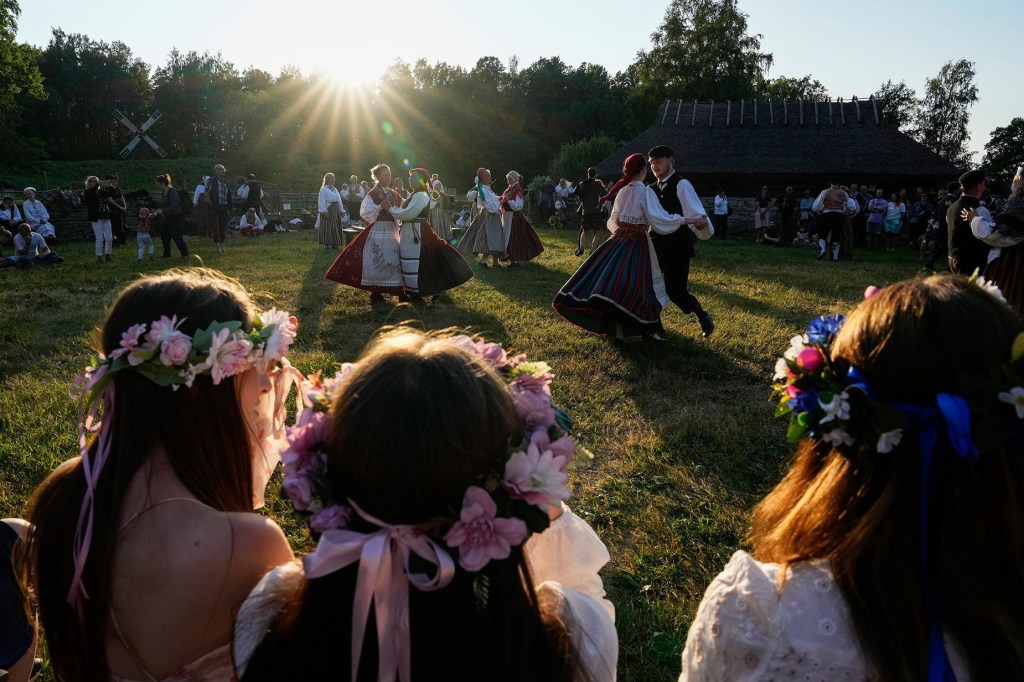
Pavel Golovkin/AP
People dressed in traditional clothing dance during celebrations of Midsummer Day at the Open Air Museum in Tallinn, Estonia, on June 23, 2023.
https://amp.cnn.com/cnn/travel/summer-solstice-celebrations-traditions-world-scn
 Myths & Mischief
You must be logged in to post a comment.