
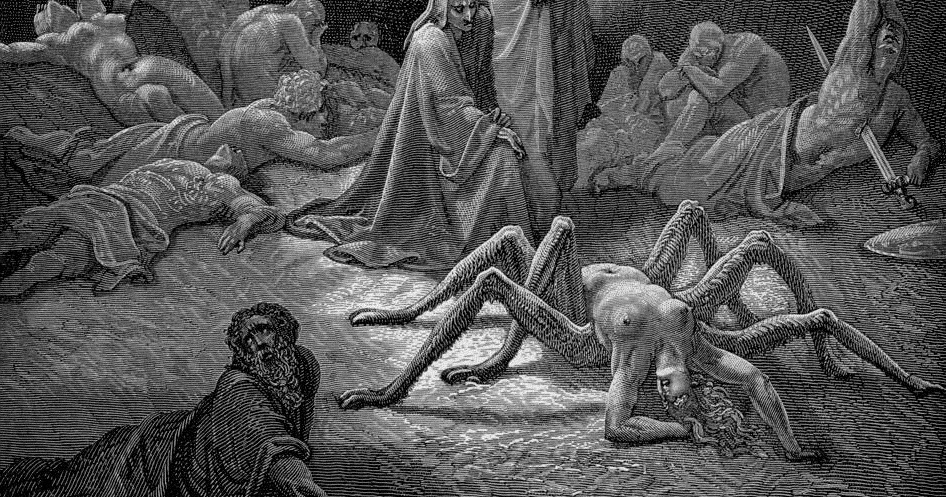
Greek Mythology is full of punishments handed down by the Olympians.
Some, like Narcissus, are justified, I mean, the man had a serious issue with vanity.
Others, however, were punished with undue cause, such as Callisto, who was turned into a bear after Zeus allegedly seduced her. I say allegedly, because we all know Zeus paid little mind to boundaries, autonomy, or consent.
It is hard to fathom why so many, especially women, in Greek mythology were subjugated to such unrealistic consequences for their actions. I understand if a God were disrespected, but accidents (such as Actaeon) did not warrant such harsh reactions. It is as if the progenitors of the myths enjoyed the suffering of mortals in tales of the Gods.
The tale of Arachne
There are several versions of the myth involving Arachne and Athena. Each depicts a different beginning to the weaving contest and outcomes for the contest, but ultimately, all point to Arachne being the matriarch of spiders. While it is not evident, each version likely originates from various locations in Ancient Greece.
In one version, Arachne boastfully claims she is a better weaver than Athena, in Athena loses to the mortal woman and turns her into a spider out of anger. A second version depicts a more friendly contest, but Athena transforms Arachne to teach the mortal a lesson in humility and respect, as Arachne has woven a tapestry depicting Zeus’ various advances on mortal women. Yet a third version maintains the boastful claims of Arachne, who ultimately loses the contest. Out of despair, Arachne hangs herself, to which Athena showed pity for the woman’s skills and transformed her into a spider.
Just Punishments
I cannot begin to imagine the machinations of the Olympians. In many instances, they are as unpredictable as the weather and as dangerous as the open sea. But many of their punishments, at least from my standpoint, are grossly overcompensating for the lack of skills or minor misunderstandings.
Personally, I would find it difficult to punish a mortal who was more skilled than I. I would rather do as the Fae, who tended to kidnap talented humans for their personal enjoyment, than punish them. Suffice it to say, turning Arachne into a spider simply because she was a better weaver than Athena is a bit absurd.
An Unfortunate Circumstance
Be that as it may, it is unfortunate what happened to Arachne, as with some many women in the Ancient Greek world. Too many times do we see talented, beautiful, and independent women punished, tortured, and downright abused by the very beings that should have protected them. We have read tales of Zeus exercising his fertility far too often, only for his victims to be punished for his crimes. Or, like in Medusa’s case, we see the woman punished by the very goddess they devoted themself to. Either way, many of the punishments, especially those suffered by women, are outrageous and despicable. Arachne’s punishment (I will leave it to you whether it is justified or not) is just another in the long list of those heinous crimes carried out by Olympians.
Interestingly Enough
While Arachne’s punishment at the hands of Athena seems unjust, and even downright cruel, there is a bit of a laugh that comes from this tale. Arachne, as it stands, or at least the myth does, appears to be the origin of our current scientific designation for spiders, Arachnida. It makes sense given she was transformed into a spider by the Goddess of War, allowing her and her progeny to weave for the rest of eternity.
Just Scratching the Surface
Be that as it may, we are just beginning to scratch the surface of those wronged by the Olympians. We know all too well that many of the ‘heroes’ of antiquity were far worse than the monsters they slew, the rulers were no better than the criminals they condemned, and the deities were vicious and cruel. I would rather face a thousand plagues than deal with the wrath of an Olympian over a perceived slight or misunderstanding. Better yet, I would rather be a victim of Vlad the Impaler during the invasion of the Turks rather than be a woman who may or may not have garnered the unknowing attentions of a philanderous ruling God who knew nothing of consent or boundaries.
Yes, many of the stories from Ancient Greece are entertaining, but they are also laced with layer upon layer of disgusting behavior that makes Dohmer look docile by comparison.
Sources:
GreekMythology.com, The Editors of Website. “Arachne”. GreekMythology.com Website, 08 Apr. 2021, https://www.greekmythology.com/Myths/Mortals/Arachne/arachne.html. Accessed 12 May 2025.
The Editors of Encyclopaedia Britannica. “Arachne”. Encyclopedia Britannica, 24 Jan. 2025, https://www.britannica.com/topic/Arachne. Accessed 12 May 2025.
Giesecke, Annette. Classical Mythology A to Z. Black Dog & Leventhal Publishers, 2020.
“Arakhne.” ARACHNE (Arakhne) – Lydian Weaver of Greek Mythology, http://www.theoi.com/Heroine/Arakhne.html. Accessed 12 May 2025.
 Myths & Mischief