
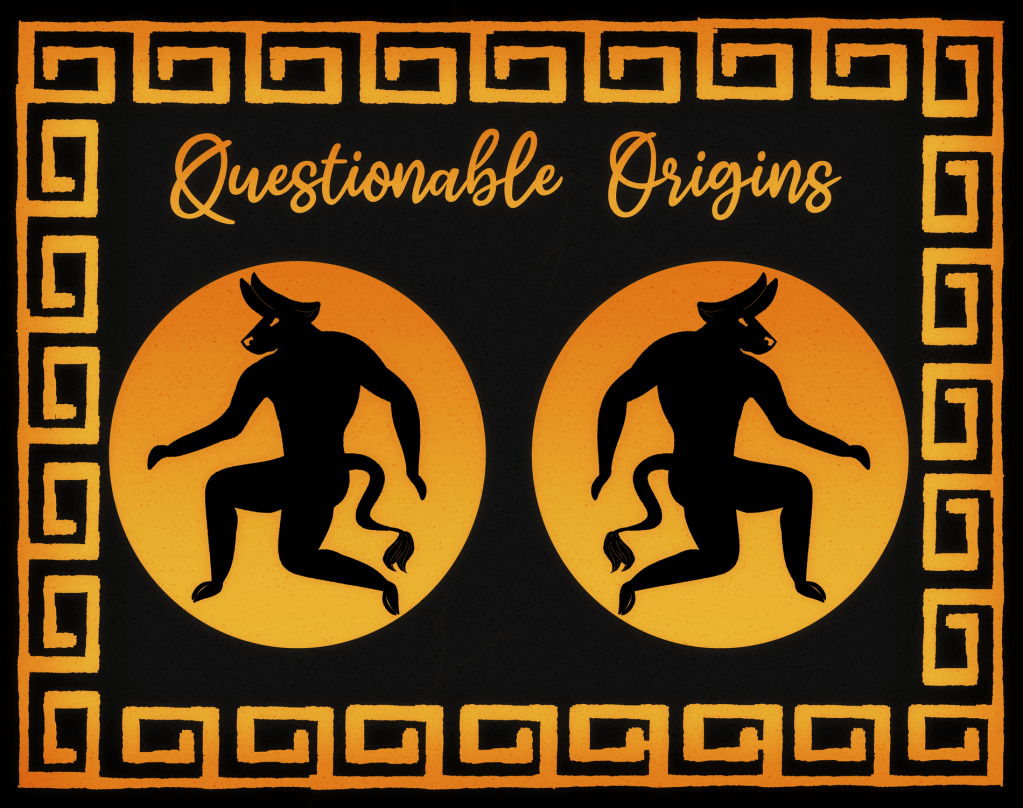
Arguably, one of the most universal experiences of anyone who falls into both the categories of “Geeky Inclined” and “Internet Savvy” is finding a piece of media —usually a modern interpretation of a myth in the form of a fanfiction or comic— and, falling in love with it, you think to yourself “I want to learn more about the source material!” Then you end up looking at the most grotesques, horrific, questionable thing your eyes have ever seen, leading to you question everything you’ve ever loved before.
My name is Kira, and let’s talk about one of those questionable origins, shall we!
Minotaur
The technical origins of minotaurs are rooted in Greek mythology. Minotaurs originate from Ovid’s poem, Metamorphoses. Minotaurs, generally, come in one of three depictions: a human with a bull’s head, a humanoid with a bull’s head and torso along with a human lower body, or an anthropomorphic bull. Due to the blood thirsty nature of the original Minotaur, most are depicted as evil, or neutral. Minotaurs in modern interpretations, typically have sentience along with human, or just below human, intelligence. But now onto the fun part, the Mythological origins!
The mythology is where things get interesting! With the growing popularity of the Odyssey, thanks to the musical EPIC written by the talented Jorge Rivera-Herrans, people are once again falling in love with the God of the Seas, Poseidon. But did you know when he’s not hunting down the king of Ithaca —or anyone else who harms one of his children really— he’s seeking revenge in much more, shall we say, “interesting” ways.
Cue, King Minos.
When King Minos of Crete was looking for a way to prove he had the divine favor of the Gods, he turned to Poseidon for such a sign. The symbol came in the form of a pure white, powerful bull to be sacrificed in Poseidon’s honor, called the Cretan Bull. In some versions of the myth, King Minos was to find the finest bull born in Crete and sacrifice the calf in the name of Poseidon every year, and one year the bull in question was the most beautiful bull ever born; white as snow and the strongest in its herd. In other versions the Cretan Bull was originally Poseidon’s, and he gave the bull to King Minos to be sacrificed. Either way, King Minos got the symbol he had wished for, and not wanting to part with the bull, he chose to sacrifice a common bull and keep the Cretan Bull for himself. This did not sit well with the god of the sea.
Poseidon chose not to do anything directly, deciding to scheme instead. With an idea that he knew would tickle her fancy, Poseidon went to Aphrodite and asked her to make King Minos’s wife, Pasiphaë, shall we say, “fall in love” with the Cretan Bull. This plan worked. However, a little too well. To keep it PG-13, Pasiphaë got the help of an underpaid, overworked royal engineer, Daedalus, to make her an ancient fursuit.
When it was revealed that Pasiphaë was pregnant, everyone was excited that King Minos was going to have an heir. That excitement didn’t last, however, when the long-awaited prince was born, and it was obvious King Minos wasn’t the father —the Cretan Bull was. The child was also born with a curse to crave human flesh. King Minos called upon Daedalus once again, this time to make a labyrinth to trap the child in. Prisoners were thrown into the labyrinth to feed the monstrous child, for fear it would escape and eat anyone in sight otherwise. That was until the hero, Theseus, who was thrown into the labyrinth and slayed the cursed prince, with the help of the Minotaur’s own sister, Ariadne.
That was the end of the Minotaur. There are many more stories here we didn’t cover, however. Remember the royal engineer that both Pasiphaë and King Minos called upon for their plans, Daedalus? He is Icarus’s father. Pasiphaë is an interesting character herself—despite being reduced to nothing more than King Minos’s wife and the Minotaur’s mother here in order to streamline the article— not only is she divine, but is the full-blooded sister to Circe, and is described as just as powerful in the ways of herbs and magic. And let’s not forget, according to Dante’s Divine Comedy, King Minos ends up at the entrance to Hell, being the demon who tells other damned souls which ring of inferno they are sentenced to for eternity.
But, alas, this is where our story ends—for now. Keep an eye out for other questionable origins, along with so many other amazing things here at Myths & Mischief!
Yah’ Wee! (Thank you!)
 Myths & Mischief